RMIT University’s FISU Healthy Campus Accreditation Builds On University-Wide Wellbeing Work
Posted: 24/09/2026
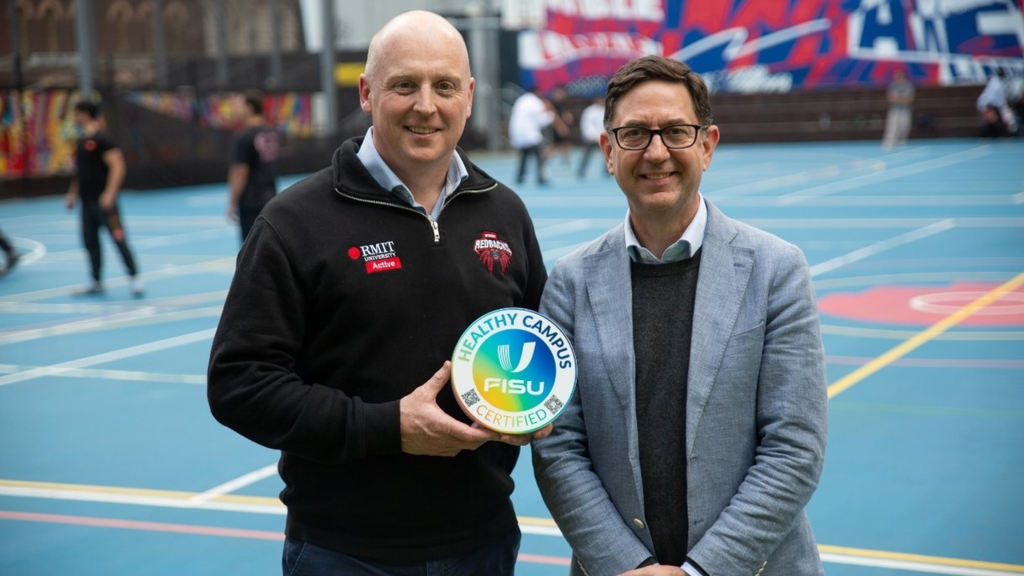
Photo Credit: RMIT University Steve Harrison (Manager, Sports & Fitness) presenting Dene Cicci (Executive Director, Students) with RMIT’s FISU Healthy Campus Certified plaque
RMIT University has achieved FISU Healthy Campus accreditation, recognising the range of work underway to support student health and wellbeing across the university.
RMIT became a signatory to the FISU Healthy Campus Program in 2025 and achieved accreditation after meeting 40 criteria across six domains: Healthy Campus Management, Physical Activity and Sport, Nutrition, Disease Prevention, Mental and Social Health, and Risk Behaviour.
For RMIT’s Manager, Sports & Fitness, Steve Harrison, the accreditation process has been about more than demonstrating that the university meets the program’s criteria. It has provided an opportunity to look broadly at RMIT and see how different areas are contributing to student wellbeing.
“The biggest takeaway has been discovering how much great work is already happening across RMIT, much of which some of us weren’t fully aware of,” Steve said.
The process brought university colleagues together to share ideas, identify initiatives and contribute to RMIT’s accreditation submission. For Steve, the willingness of colleagues to collaborate has been a standout of the journey.
“One of the things I value most about the Healthy Campus framework is the way in which it is uniting people around a common goal. RMIT is full of talented and passionate staff who care deeply about student success, and it’s exciting to see the connections being made. Student wellbeing is influenced by many parts of the university experience, so the best outcomes come when we work together.”
That whole-of-university approach is reflected in the initiatives recognised through RMIT’s accreditation.
Programs such as RMIT Active, the Student Sports Festival, Learn to Swim and Beach Water Safety Day provide opportunities for students to be active, build confidence and connect with others.
RMIT’s approach also extends beyond sport and recreation, with initiatives such as RMIT Eats providing food relief while encouraging social connection and engagement with other wellbeing programs. During Semester 1 2026, more than 2,800 grocery bags were distributed through the program, with participating students introduced to RMIT Active opportunities and offered waived fees to join student clubs.
The accreditation process has also helped RMIT establish a clearer baseline for future development, while identifying opportunities to strengthen its approach to student wellbeing.
“This accreditation recognises the breadth of work already happening across RMIT, while challenging us to keep improving how we create those conditions for every student,” said Dene Cicci, RMIT’s Executive Director, Students.
Maintaining the accreditation will require continued progress, giving RMIT an ongoing framework to build on what is already in place and continue strengthening its approach to student wellbeing.
“We’re really only getting started,” Steve said.
“Over the next phase, we’ll bring together the many existing health and wellbeing programs across RMIT under a single Healthy Campus banner. This will make it easier for students and staff to discover and access the support available to them. From there, we’ll use the Healthy Campus framework to introduce new initiatives and strengthen partnerships to drive greater impact.”
Learn more about RMIT’s FISU Healthy Campus accreditation here.
Stay up to date with Healthy Campus news from Australia and around the world.
UniSport acknowledges and pays respect to all traditional custodians of the lands of which we run, jump and throw throughout Australia. We pay respect to elders both past, present and emerging.